
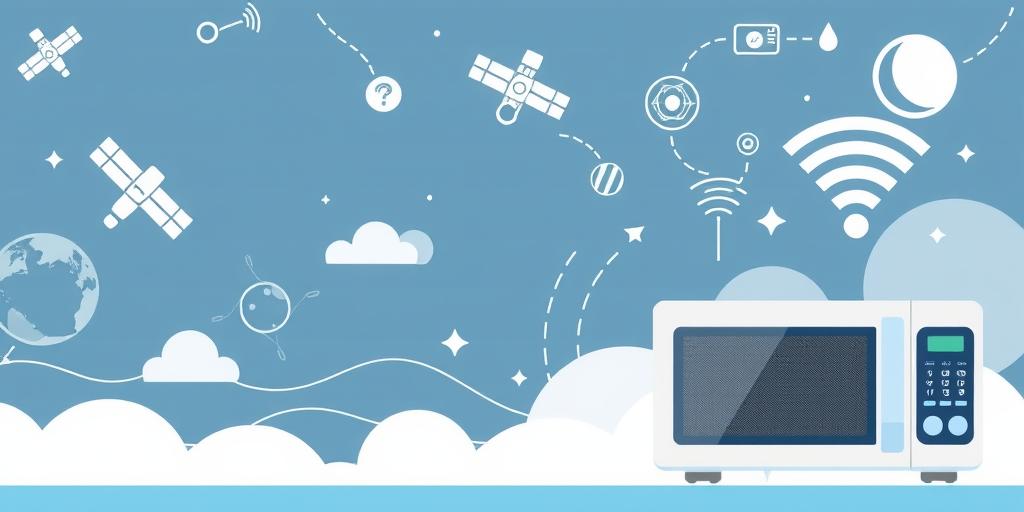
The Science Behind Common Technologies: GPS, WiFi, and Microwaves
We live in an age where technology is seamlessly integrated into our daily lives. But how often do we stop to consider the science that makes these everyday marvels possible? This post will delve into the fascinating science behind three common technologies: GPS, WiFi, and microwaves.
GPS: Navigating with Satellites
GPS, or Global Positioning System, is a satellite-based navigation system that provides location and time information anywhere on or near the Earth. But how does it work?
- Satellite Constellation: GPS relies on a constellation of at least 24 satellites orbiting the Earth. These satellites continuously transmit signals.
- Trilateration: A GPS receiver on the ground (like the one in your smartphone) picks up signals from multiple satellites. By measuring the time it takes for these signals to arrive, the receiver can calculate its distance from each satellite.
- Position Calculation: With distance measurements from at least four satellites, the receiver can pinpoint its precise location using a mathematical technique called trilateration. Three satellites are needed for horizontal position, and a fourth is needed for altitude and to correct for receiver clock errors.
The Science: GPS relies on fundamental principles of physics, including the constant speed of light and the geometry of spheres. Atomic clocks onboard the satellites ensure incredibly accurate timekeeping, which is crucial for precise distance calculations. Einstein's theory of relativity even plays a role, as the effects of time dilation on the satellites must be accounted for.
WiFi: Wireless Internet Access
WiFi, or Wireless Fidelity, allows devices to connect to the internet wirelessly. It has become an indispensable technology in homes, offices, and public spaces.
- Radio Waves: WiFi transmits data using radio waves, a form of electromagnetic radiation. These waves travel through the air, carrying information between your device and a wireless router.
- Routers and Access Points: A wireless router acts as a central hub, receiving data from the internet and transmitting it to devices via radio waves. Access points extend the range of a WiFi network.
- Standards and Protocols: WiFi operates on specific standards (like 802.11a/b/g/n/ac/ax) that define the frequencies, data rates, and protocols used for communication. These standards ensure compatibility between different devices and networks.
The Science: WiFi utilizes the principles of electromagnetism and signal processing. The radio waves used in WiFi are a part of the electromagnetic spectrum and are governed by Maxwell's equations. Modulation techniques are used to encode data onto the radio waves, and sophisticated algorithms ensure reliable data transmission even in the presence of interference.
Microwaves: Cooking with Electromagnetic Radiation
Microwave ovens use electromagnetic radiation to heat food quickly and efficiently.
- Magnetron: The heart of a microwave oven is the magnetron, a vacuum tube that generates microwaves.
- Waveguide: The microwaves are channeled through a waveguide, a metal tube that directs them into the cooking chamber.
- Water Molecules: Microwaves cause water molecules in food to vibrate rapidly. This vibration generates heat, which cooks the food from the inside out.
The Science: Microwaves are a form of electromagnetic radiation with a frequency of around 2.45 GHz. At this frequency, water molecules efficiently absorb the energy, leading to rapid heating. The metal walls of the microwave oven contain the radiation, preventing it from escaping and potentially harming the user.


