
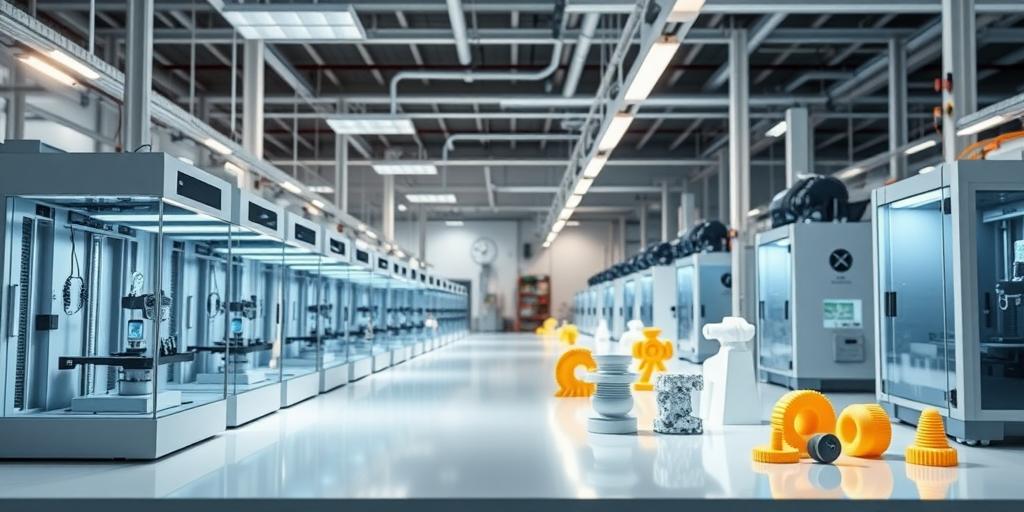
3D printing, also known as additive manufacturing, is rapidly transforming industries from manufacturing to medicine. This innovative technology builds three-dimensional objects from a digital design by adding layer upon layer of material, be it plastic, metal, ceramics, or even biological materials.
Revolutionizing Manufacturing
Traditional manufacturing processes often involve subtractive methods, where material is removed to create the desired shape. 3D printing, conversely, offers several advantages:
- Rapid Prototyping: Engineers and designers can quickly create prototypes to test designs and iterate improvements, drastically reducing time-to-market.
- Customization: 3D printing enables the production of highly customized products tailored to individual needs, without the added cost typically associated with small-batch manufacturing.
- Complex Geometries: Intricate designs and complex geometries that are difficult or impossible to achieve with traditional methods can be readily produced.
- On-Demand Production: Parts can be printed as needed, reducing the need for large inventories and minimizing waste.
- Material Innovation: The technology drives innovation in material science, leading to the development of new materials with enhanced properties.
Applications in Medicine
3D printing is making significant strides in the medical field, offering unprecedented opportunities for personalized healthcare:
- Prosthetics and Implants: Custom-designed prosthetics and implants can be created to precisely fit a patient's anatomy, improving comfort and functionality.
- Surgical Planning: Surgeons can use 3D-printed models of a patient's organs or bones to plan complex procedures, enhancing precision and reducing risks.
- Bioprinting: Researchers are exploring bioprinting techniques to create functional tissues and organs for transplantation, potentially revolutionizing regenerative medicine. This involves printing living cells and biomaterials to construct three-dimensional biological structures.
- Personalized Medications: 3D printing can be used to create customized drug dosages and delivery systems tailored to individual patient needs.
Challenges and Future Directions
Despite its immense potential, 3D printing faces certain challenges:
- Material Limitations: The range of materials that can be effectively used in 3D printing is still limited compared to traditional manufacturing.
- Scalability: Scaling up production to meet mass-market demand remains a challenge.
- Cost: The cost of 3D printing can be prohibitive for certain applications, although it is decreasing over time.
Looking ahead, advancements in materials, printing technologies, and software are expected to overcome these challenges. 3D printing is poised to play an increasingly important role in manufacturing, medicine, and various other industries, enabling greater customization, efficiency, and innovation. As the technology continues to evolve, its impact on society will only continue to grow.


