
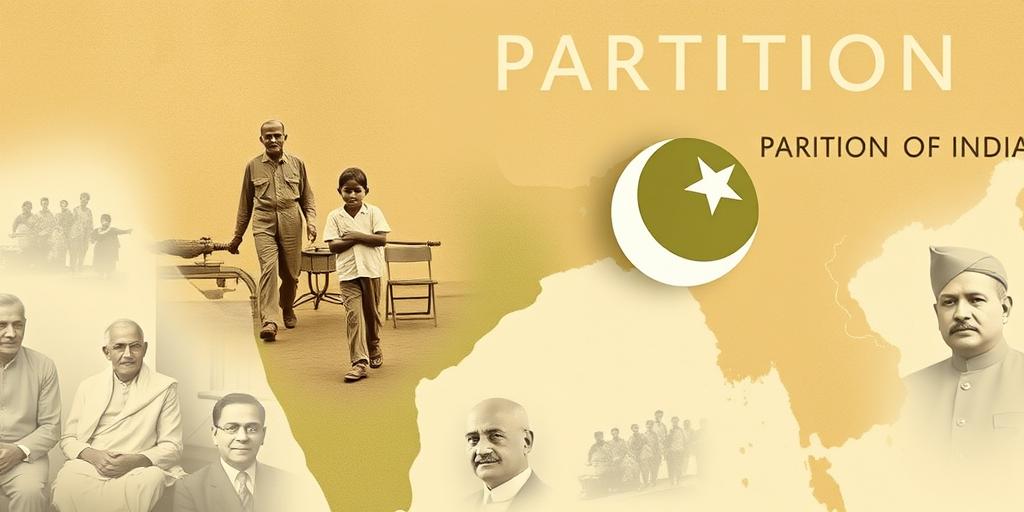
The Partition of India, a pivotal event in the 20th century, remains a topic of significant historical and human interest. This event, occurring in 1947, led to the creation of independent India and Pakistan. While intended to resolve communal tensions, it resulted in widespread displacement, violence, and lasting geopolitical consequences.
Historical Context
British colonial rule in India, which began in the 18th century, saw increasing nationalist movements advocating for self-governance. By the early 20th century, the Indian National Congress and the Muslim League emerged as key political forces. The former aimed for a unified India, while the latter, led by Muhammad Ali Jinnah, sought to protect the rights and interests of Muslims, eventually advocating for a separate Muslim state.
The decision to partition British India was influenced by several factors:
- Communal Tensions: Growing religious and political divisions between Hindus and Muslims fueled the demand for separate states.
- British Policy: The British government, under Prime Minister Clement Attlee, accelerated the process of granting independence, leading to the hasty demarcation of borders.
- Political Expediency: Key leaders, including Jawaharlal Nehru and Jinnah, ultimately accepted partition as a means to achieve independence, albeit with differing visions for the future.
The Partition Plan
The partition plan, enacted through the Indian Independence Act 1947, divided British India into two sovereign nations: India and Pakistan. The Radcliffe Line, named after Sir Cyril Radcliffe, was commissioned to demarcate the borders between the two new nations. This division was based on religious demographics, with Muslim-majority areas allocated to Pakistan and Hindu-majority areas to India.
Human Cost
The partition resulted in one of the largest mass migrations in human history. Approximately 10-12 million people were displaced, as Hindus and Sikhs moved to India and Muslims moved to Pakistan. This migration was accompanied by widespread violence, riots, and communal clashes, leading to the deaths of an estimated 1-2 million people.
The human cost of the partition included:
- Mass Displacement: Millions lost their homes and livelihoods, becoming refugees in unfamiliar and often hostile environments.
- Widespread Violence: Communal violence claimed countless lives and left deep scars on communities, with women and children particularly vulnerable.
- Economic Disruption: The partition disrupted trade, agriculture, and infrastructure, causing long-term economic challenges for both nations.
Long-Term Consequences
The partition continues to shape the geopolitical landscape of the Indian subcontinent. The unresolved issues surrounding Kashmir, a region with a majority-Muslim population but ruled by a Hindu monarch at the time of partition, have led to multiple wars and ongoing tensions between India and Pakistan.
Moreover, the partition left a legacy of communalism and mistrust that persists in both countries. While efforts have been made to foster peace and reconciliation, the wounds of partition remain a sensitive and complex issue.
Conclusion
The Partition of India was a complex event with far-reaching consequences. While it led to the independence of India and Pakistan, it also resulted in immense human suffering and enduring geopolitical challenges. Understanding the history and human cost of the partition is crucial for fostering informed perspectives on South Asian history and contemporary issues.


