
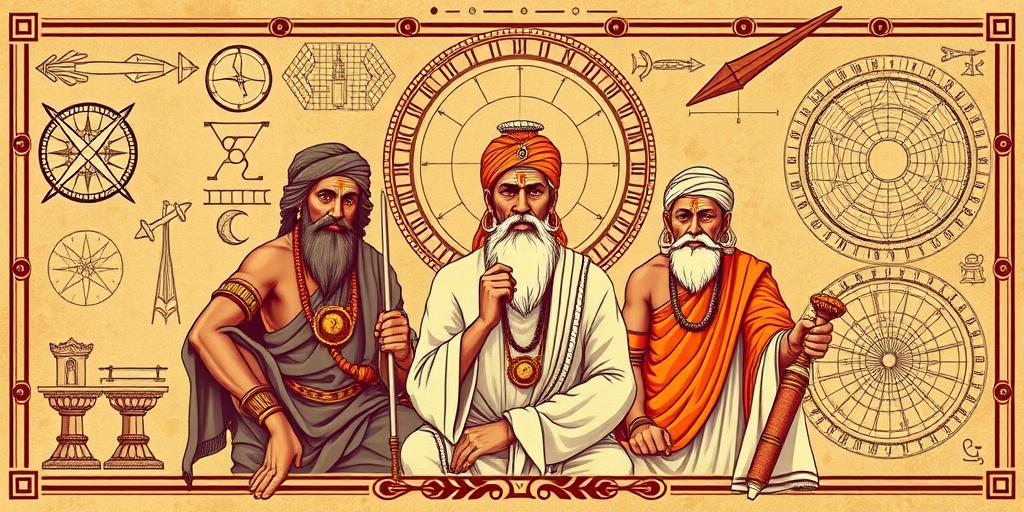
Ancient Indian Contributions to Science and Mathematics
India's rich history is not only filled with cultural and spiritual heritage but also significant contributions to the fields of science and mathematics. These advancements, developed centuries ago, have had a profound impact on the world and continue to influence modern science. This post will explore some of the most remarkable achievements of ancient Indian scholars and scientists.
Mathematics
The Concept of Zero
One of the most fundamental contributions of ancient India to mathematics is the concept of zero. While the idea of nothingness had existed, it was the ancient Indian mathematicians who first conceived of zero as a number and a placeholder in the decimal system. This innovation, attributed to Brahmagupta in the 7th century CE, revolutionized mathematics and paved the way for advanced arithmetic and algebra.
The Decimal System
The decimal system, with its base of 10, was another significant contribution. This system, which originated in India, allowed for easier calculations and more efficient representation of numbers. The decimal system, along with the concept of zero, was later adopted by Arab scholars and eventually spread to Europe, transforming mathematical practices worldwide.
Algebra
Ancient Indian mathematicians made substantial progress in algebra. Aryabhata, in the 5th century CE, developed methods for solving linear equations, while Brahmagupta provided solutions for quadratic equations. These algebraic techniques were crucial for advancements in astronomy, engineering, and other scientific fields.
Trigonometry
Trigonometry, the study of the relationships between angles and sides of triangles, also saw significant development in ancient India. Aryabhata introduced the concepts of sine, cosine, and versine, which were essential for astronomical calculations. His work laid the foundation for the development of modern trigonometry.
Science
Astronomy
Astronomy was a highly developed science in ancient India. Indian astronomers made accurate observations of celestial bodies and developed sophisticated models of the solar system. Aryabhata proposed that the Earth rotates on its axis and revolves around the Sun, centuries before Copernicus. Indian astronomers also calculated the length of the solar year with remarkable precision.
Medicine
The ancient Indian system of medicine, Ayurveda, is one of the oldest medical systems in the world. Ayurveda emphasizes the balance of mind, body, and spirit and uses herbal remedies, diet, and lifestyle changes to promote health. Sushruta, a surgeon who lived in the 6th century BCE, is renowned for his surgical techniques, including rhinoplasty and cataract surgery. The Charaka Samhita and Sushruta Samhita are comprehensive texts that detail various aspects of Ayurveda.
Metallurgy
Ancient Indians were skilled metallurgists, producing high-quality metals and alloys. The Iron Pillar of Delhi, which dates back to the 4th century CE, is a testament to their expertise. The pillar has stood for centuries without rusting, demonstrating the advanced metallurgical techniques of the time. Wootz steel, a type of high-carbon steel, was also developed in India and was highly prized for its strength and durability.
Engineering and Architecture
The engineering and architectural achievements of ancient India are evident in the construction of temples, cities, and irrigation systems. The Indus Valley Civilization, which flourished around 2500 BCE, had well-planned cities with advanced drainage and sanitation systems. The construction of the Great Bath at Mohenjo-daro showcases their understanding of hydraulics and water management.
Conclusion
The contributions of ancient India to science and mathematics are vast and significant. From the concept of zero to advanced surgical techniques, ancient Indian scholars and scientists made groundbreaking discoveries that have shaped the world we live in today. Recognizing and celebrating these achievements is essential for understanding the global history of science and technology. These innovations laid the groundwork for many modern advancements and continue to inspire scientists and mathematicians around the world.


